

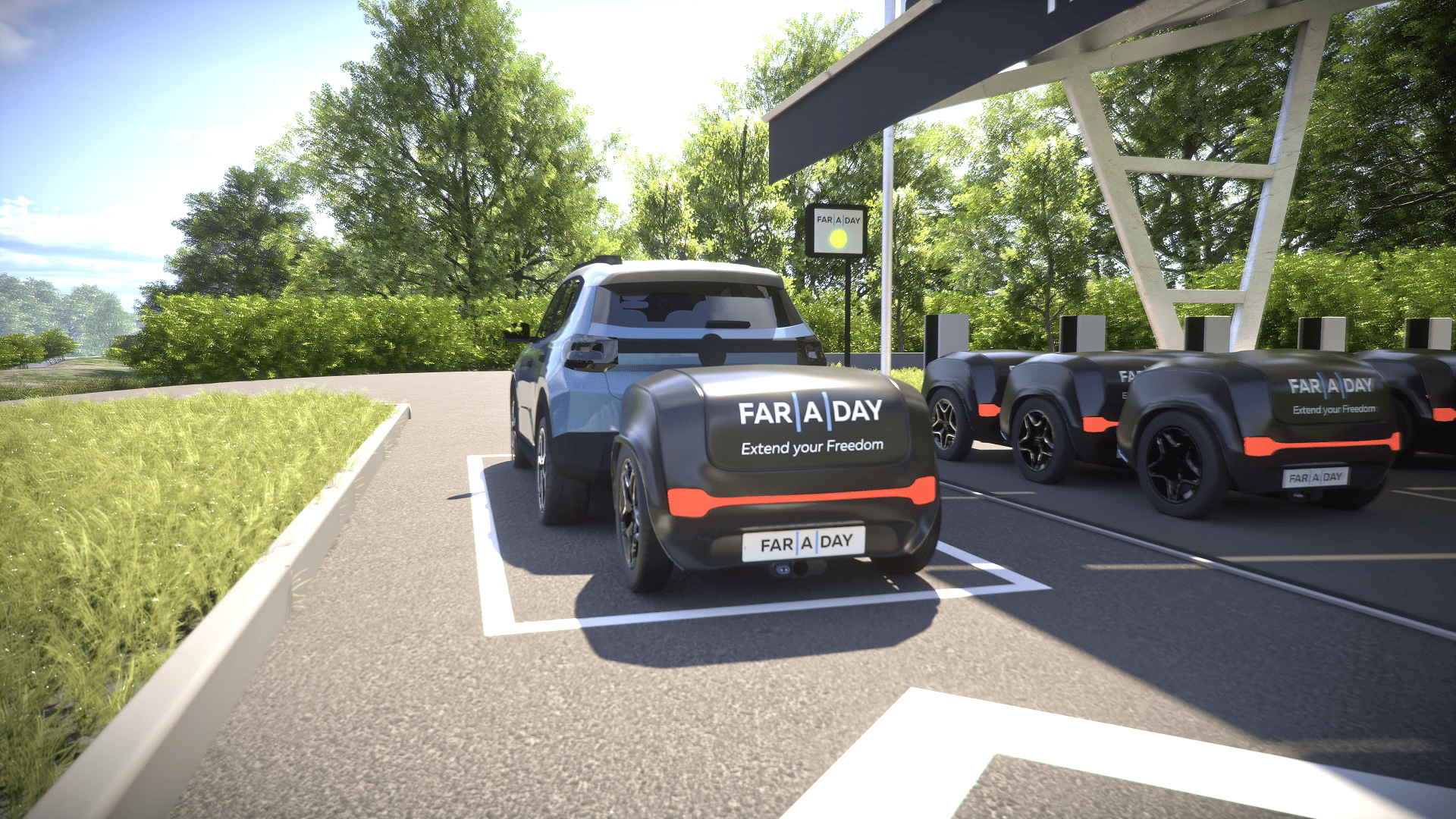
FAR-A-DAY in figures :
- +60 KWh of increased range, enabling 300 km more of real-life freeway travel
- 2-minute recharge, much faster and easier than a supercharger
- 1 app to streamline the experience: advance booking via app
- Automatic connection and disconnection, without leaving the vehicle
- 200,000 km covered by validated prototypes, with patented technology resulting from several years of R&D with automakers,
- 300 m2 of photovoltaic panels to equip and power each station
- Weight: 500 kg
- Dimensions : Width 1.25 m / Height 90cm / Added length: 1.3 m
- Perfectly transparent driving in total safety
Patented technology increases range and makes electric vehicles accessible to all
While the electric car is establishing itself as the essential solution for sustainable mobility in everyday life, its adoption by the general public is still hampered by battery autonomy and charging times on long journeys. Vehicles costing less than €25k take 30 minutes to charge, enough for 100 to 150 km on the freeway. For example, an e-208 driver has to stop 6 times to recharge on a trip from Paris to Marseille.
To remove this obstacle, FAR-A-DAY is proposing a novel approach: an intelligent network of FAR-A-DAY stations providing lightweight, modular batteries that enable everyone to extend their range in just a few minutes, without even getting out of their vehicle. This external battery, a 100% French technology, is designed in Ile de France and assembled at the heart of the Magny-Cours Technopôle, renowned for its industrial excellence and know-how in mobility.
The technology is centered on a mobile battery, which connects to the vehicle in 2 minutes and adds 60kWh to the vehicle's battery, giving over 300km of real freeway range. It can be used by all types of electric car (from city cars to utility vehicles), and has been designed in particular to equip used cars often fitted with older, more energy-hungry and less efficient batteries, enabling them to cover long distances with peace of mind. The cost of electricity will be the same as that offered by fast-charging stations.
"Thanks to our technology, we've removed the main obstacle to electric cars: we've finally succeeded in dissociating autonomy and purchase price. The French no longer need to buy expensive models to be able to drive long distances electrically. They can use a reasonably-sized electric vehicle for everyday journeys, which account for 95% of all journeys, and use our service occasionally for longer trips. In practical terms, this makes electromobility accessible to everyone, with the same freedom as combustion vehicles or electric vehicles with very large batteries."
ArthurDarde, CEO FAR-A-DAY
To date, the prototypes developed have already covered 200,000 km. Practical and adaptable to all types of electric vehicle, this technology holds a unique patent, enabling the connected battery to maneuver seamlessly in reverse.
2026 target: creation of a Paris-Bordeaux corridor
At the heart of the FAR-A-DAY project is a network of stations distributed along major motorways, designed to operate almost autonomously, without systematic dependence on the traditional electricity grid, thanks to photovoltaic panels. The local production of part of the energy will enable electricity costs to be kept under control.
After reserving their Faraday on the mobile app, customers can pick it up in 2 minutes at a station at the entrance to the freeway, and drop it off or exchange it at rental points spread out over a 100 km grid.
In 2026, the start-up aims to open a first Paris-Bordeaux corridor, followed by 30 stations in 2027, covering 80% of long-distance journeys.
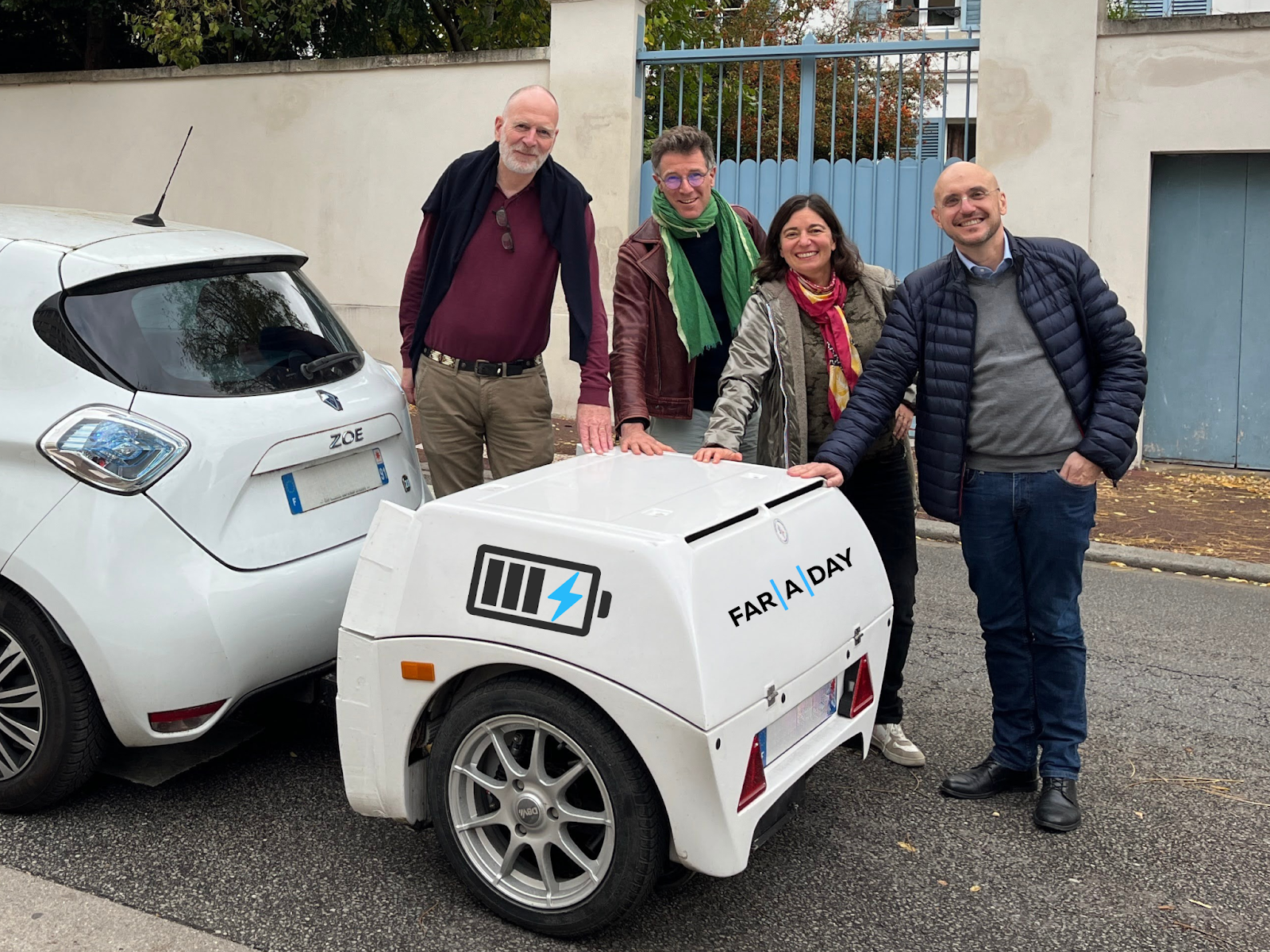
The FAR-A-DAY founding team with the external battery prototype
Arthur DardeCEO, energy and EV ecosystem expert, ex-Otoqi and Bump, scale-up specialist. - Jean-Baptiste Segardvisionary engineer, creator of the EP Tender technology at the heart of FAR-A-DAY, ex-Asset Manager at UBP, Société Générale, BNP Paribas. - Marie LaloyCMO, brand and impact specialist, ex-Stellantis, Ucar, Aramisauto. Nominated CMO of the Year 2024. - Arnaud VilleneuveCTO, deeptech specialist, ex-CTO Blue Frog Robotics and EV systems engineer at Renault.